Text messaging gives political campaigns something no other channel can match: a direct line to supporters that gets opened within minutes. While emails sit unread and social media algorithms decide what content voters see, SMS reaches voters immediately.
Getting the most out of the reach that text messages provide requires more than sending frequent donation asks. Supporters tune out when messaging feels transactional. To build the strongest political text fundraising strategy, pair your campaign’s appeals with messages that inform, invite, and build relationships with voters.
This guide will outline how to build your campaign’s political texting strategy, from choosing a platform to writing messages that move people to act.
Get the latest insights in momoGood’s Texting Insights Report
Download the report →What is a political text messaging service?
A political text messaging service is a software platform that enables campaigns to send SMS and MMS messages to voters and donors on a large scale. Unlike general business texting tools, these platforms are designed for the specific needs of political outreach: large contact lists, donor segmentation, fundraising, and more.
Texting software allows you to send both broadcast and one-to-one messages. Broadcast messaging sends mass messages to your entire list at once, making it ideal for general fundraising appeals, event announcements, and get-out-the-vote (GOTV) reminders. On the other hand, one-to-one texting allows you to send individual texts for voter persuasion and hold two-way conversations.
Some political text messaging services also help you lease short codes and get your phone number registered with carriers so you can start texting faster. Text platforms also give your team tools to manage opt-ins and opt-outs, segment contact lists, track delivery and engagement metrics, and run A/B tests.
Why use SMS for your political campaign?
Few outreach channels match SMS for direct, immediate access to supporters. Marketing texts have an open rate of over 99%, and 90% of text messages are read within three minutes of delivery. This speed can help your campaign make the most of time-sensitive asks, including donation deadlines, GOTV pushes, and last-minute event reminders.
SMS also helps you meet voters where they already are. Most people carry their phones with them throughout the day, which means a well-timed text can reach supporters at any moment, not just when they’re checking emails or scrolling their social media feeds.
Common types of political text messages
Your campaign can use political text messaging to achieve a wide variety of goals. Fundraising tends to get the most attention, but SMS is just as useful for volunteer recruitment, event reminders, voter engagement, and election day mobilization.
Fundraising
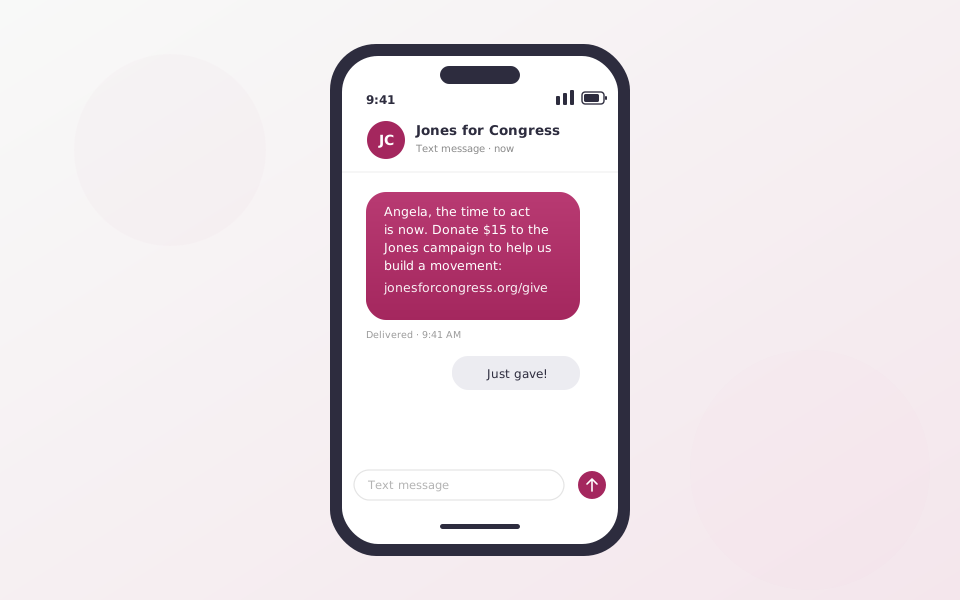
SMS is one of the most effective channels for driving donations. A text is a great choice for urgent fundraising asks and rapid-response moments. Pair a well-crafted message with a direct link to your campaign’s donation page to drive conversions and remove friction from the giving process.
Get out the vote (GOTV)
GOTV texting is a great way to use SMS for your campaign. In the days and hours before an election, you can remind supporters of polling locations and hours, promote early voting, and drive turnout among lower-propensity voters. The immediate delivery of SMS makes it well-suited for time-sensitive mobilization.
Volunteer recruitment and canvassing coordination
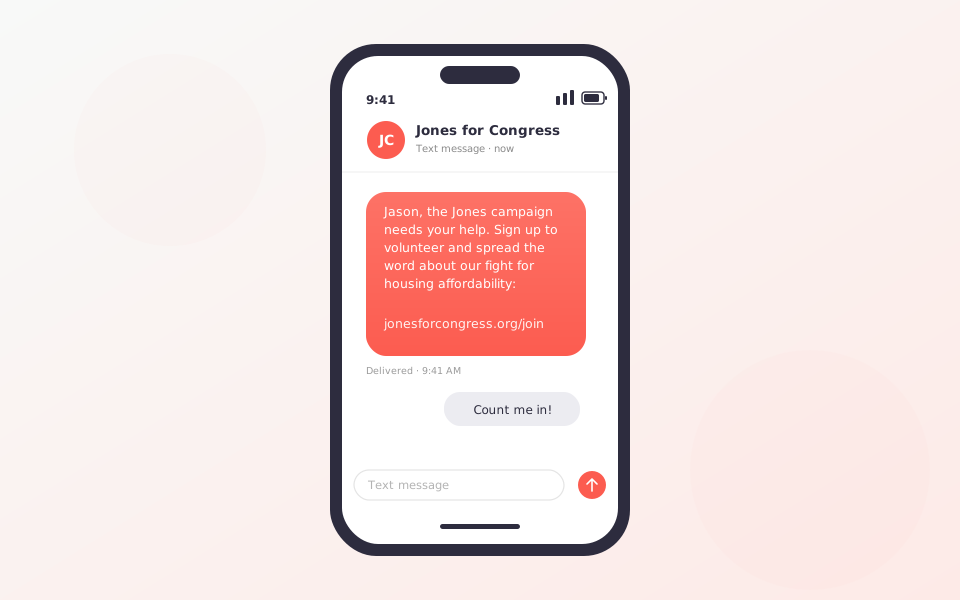
SMS can help simplify your campaign’s volunteer management processes. You can drive sign-ups with a direct link to a volunteer form, confirm canvassing shifts, provide event details, and keep volunteers engaged between actions. Two-way messaging makes it easier for volunteers to respond with questions or availability.
Voter engagement
Not every text needs to ask for a donation. Campaign updates, policy announcements, town hall invitations, and calls for feedback give your supporters reasons to stay connected between fundraising appeals. This kind of relationship-building helps your campaign connect with supporters in between asks.
Event updates and reminders
SMS can help your campaign keep event attendees informed. Invitation texts with RSVP links, reminder texts as the event approaches, and day-of logistics updates all help you get more out of your campaign events without much additional effort.
How to get started with political texting
Every campaign’s strategy will look different depending on the size of the campaign and the platform you choose, but a few basic concepts apply across the board. Establishing a strong foundation before your first send will save your campaign team time and help you avoid common pitfalls.
To set up SMS for your political campaign, you should:
- Choose a platform built for political campaigns. General-purpose texting tools often lack the compliance, deliverability, and reporting capabilities required for political outreach. Look for a platform that supports both mass and one-to-one messaging, handles carrier registration, and works with your existing voter database or CRM.
- Register your campaign. Most carriers require political campaigns to complete a verification process before sending text messages to voters. This process involves registering your sending number and confirming your campaign’s identity so that you can avoid being blocked or filtered when you begin sending messages.
- Build your contact list. Begin with supporters who have explicitly opted in to receive texts. You can expand your list through website sign-up forms, event sign-ins, and other outreach channels.
- Plan your messaging. Decide what you want to accomplish and how SMS fits into your broader outreach calendar. Think about how often you want to text, which groups of supporters to prioritize, and how your texts will work alongside your email and social media efforts.
- Send, measure, and adjust. Start with a small test send before scaling up, and track open rates, click-through rates, and opt-out rates from the start so you can refine your approach over time.
Once these pieces are in place, your campaign has everything it needs to start texting supporters, tracking results, and building a strategy that improves with every send.
Get all of the benefits of SMS marketing with momoGood.
Schedule a free demo →Best practices for political text messaging
Engaging voters with texts takes more than simply sending messages. What you send between fundraising asks, how you segment your contact list, and how you test your messages affect whether supporters stay engaged or tune out.
Build relationships before you make asks
Supporters who hear from you between donation requests are more likely to respond when you do ask. Our 2025 Texting Insights Report, based on nonprofit text fundraising programs, found that engagement texts generated a 3.28% click-through rate and $3.03 ROI per dollar spent.
For comparison, fundraising texts raised $4.38 per dollar spent, meaning direct solicitation made only a $1.35 difference in ROI. The revenue that engagement messages generated without asking for donations demonstrates that these texts are valuable in their own right, not only as warm-ups for your campaign’s next fundraising appeal.
Add policy updates, event invitations, and campaign news to your campaign’s SMS calendar in between scheduled fundraising messages. Supporters who feel informed and connected are more likely to respond when you make your next ask.
Use list segmentation to send more relevant messages
Dividing your contacts into groups based on past behavior, geography, or level of engagement lets you send messages that are relevant to each supporter. A past donor deserves a different message than someone who has never given. A supporter in a competitive district needs different information than one in a safe seat. A political text messaging system with segmentation features makes it easier to build these groups and manage them automatically.
Use A/B testing to continue improving your approach
Testing two versions of a message against a portion of your list before sending the better-performing version to everyone else takes the guesswork out of your SMS strategy. Test calls to action, send times, message length, or offer framing. Over time, the data from these tests will sharpen your approach and improve your results across the board.
Navigating compliance for political texts
Political text messaging operates under unique legal requirements, and rules vary depending on your race, election level, and jurisdiction. Federal frameworks like the Telephone Consumer Protection Act (TCPA) can help your campaign establish a baseline, but different states and municipalities often have additional rules. Before you begin sending messages, research the specific regulations for your campaign.
The following principles apply across most jurisdictions:
- Get explicit consent. Supporters should opt in to receive texts from your campaign. Beyond being a legal requirement in many cases, opted-in lists also tend to perform better since those contacts have already expressed interest.
- Identify your campaign clearly. Recipients should be able to tell when a message comes from your campaign. Most regulations require sender identification, and it builds trust with supporters regardless of whether it is legally required.
- Honor opt-out requests promptly. Include opt-out instructions in your messages and process removal requests quickly. Most political SMS platforms handle this automatically.
- Consult legal counsel. Compliance requirements for political campaigns can be specific to your race, district, and state. An attorney familiar with campaign communications law is the most reliable source for guidance on your situation.
momoGood handles nonprofit texting end to end — sending, replies, compliance, and text-to-give — on the same record as the rest of your fundraising.
FAQs
How can political campaigns avoid voter texting fatigue?
Combat voter fatigue by sending engagement messages. These texts give supporters an opportunity to connect outside of making a donation. Use policy updates, event invitations, and campaign news to keep your supporters engaged between fundraising appeals, which makes asks more effective when they arrive.
Why is list segmentation important for political texts?
Segmentation lets you tailor messages to specific groups based on past behavior, geography, or engagement level. A past donor, a first-time volunteer, and an unengaged contact on your list each require different messages. More relevant texts drive better results for your campaign and reduce opt-outs.
What are the primary rules and regulations for political text messaging?
Federal frameworks like the TCPA establish a baseline, but state and local requirements vary. Research the specific rules for your race, election level, and jurisdiction, and consult legal counsel rather than assuming a general compliance checklist covers your situation.
How often should my campaign send texts?
There is no universal answer, but most campaigns find that texting too frequently drives opt-outs, while texting too infrequently means supporters lose familiarity with your campaign. A mix of fundraising and engagement messages sent at a consistent cadence tends to perform better than irregular bursts. Your opt-out rate is one of the clearest signals that your frequency needs adjusting.
How do I know if my campaign’s SMS strategy is working?
The core metrics to track are open rates, click-through rates, conversion rates on specific asks, and opt-out rates. Open and click-through rates tell you whether your messages are resonating. Conversion rates tell you whether they are driving action. Opt-out rates are an early warning sign that something needs to change, whether that is frequency, content, or targeting.
Transform your ROI with momoGood
Explore how the #1 text fundraising solution can drive your campaign’s donations.