Few channels put political campaigns as directly in front of voters as a text message does. SMS open rates sit around 98%— nearly five times higher than the typical email open rate. A well-timed and well-crafted text reaches voters right where they already are, with almost nothing standing between the send and the read. That reach is why texting has become core to how modern campaigns introduce candidates, raise money, and turn supporters out to vote.
Getting the most out of the channel means pairing strong messaging with compliant, data-driven SMS strategies. To help you build a strong foundation, we’ll analyze successful examples of political text messages and how they might inspire your approach.
What are political text messages?
Political text messages are SMS, MMS, or RCS messages that a campaign, PAC, or advocacy group sends to supporters to further its goals. Text messages land on a personal device and get read quickly, making them one of the best ways to spread the word about your campaign.
Political text messages now decide the moments a campaign can’t afford to lose, whether that’s a fast-breaking news cycle or the final hours before polls close. The same logic extends past candidate races, too. Nonprofits and advocacy groups run on a similar messaging service built for nonprofits to mobilize supporters around legislation, giving days, and petition drives.
What is a political texting service?
A dedicated political texting service is the infrastructure that makes SMS strategies work at scale. SMS software typically handles a registered sending number so messages deliver reliably instead of getting filtered as spam, keeps consent and opt-out records straight so a program doesn’t get suspended mid-cycle, and gives staff a way to push urgent updates straight to supporters’ phones, something email and social posts can’t match for speed.
Understanding strict regulations for political texting
Compliance is the foundation of any texting program. Political texting draws more scrutiny than most marketing channels, from regulations at the local, state, and federal levels and from carriers deciding whether a message even gets delivered. Before a name lands on an active list, it’s crucial to get opt-in consent and offer an immediate, automated way to opt out.
TCPA provisions to keep in mind:
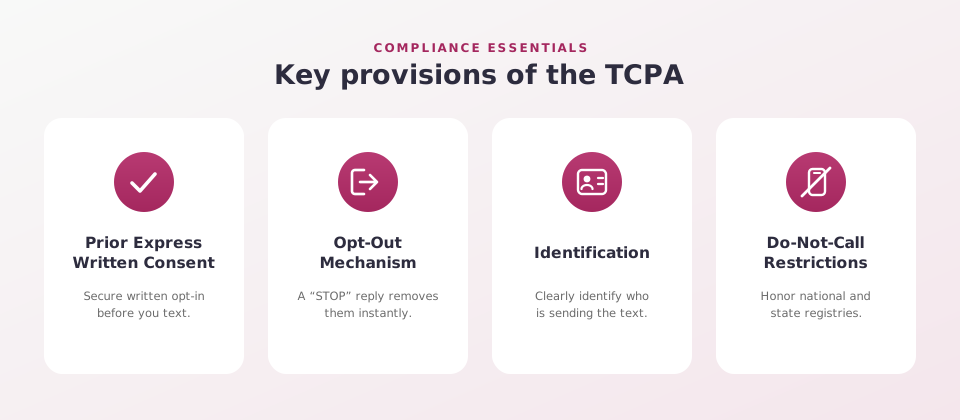
- Prior express written consent comes first. Campaigns must secure express written consent before texting constituents, typically in the form of an opt-in. You can turn touchpoints, such as donation pages or rally sign-ups, into an opt-in opportunity.
- Opt-out mechanisms have to be instant. A “STOP” reply should trigger an automatic, unconditional removal to keep your SMS list healthy. Automating this process ensures your campaign maintains good standing with carriers and constituents.
- Identification is essential. Your campaign must clearly identify who is sending the text message. Properly introducing your organization builds trust and ensures you remain compliant with carrier content guidelines.
- Do-Not-Call restrictions must be honored. Campaigns need to respect national and state Do-Not-Call registries where applicable. Scrubbing your contact lists against these registries ensures your texts only reach supporters who are open to receiving them.
Most of this starts with securing an SMS short code, which carriers require before high-volume political messages can go out without getting throttled or flagged as spam.
It’s worth repeating, however, that the regulations above are not a universal statute. Political texting regulations shift by race, state, election level, and other factors. Treat this guide as best practices rather than a compliance checklist. Always confirm what applies to your specific race with your relevant election authority or campaign counsel before launching an SMS program.
Free benchmark report
See what 136 million messages look like
Benchmarks on nonprofit SMS — send timing, reply rates, SMS versus MMS, and what actually moved revenue during Giving Season.
Strong political text message examples
A tested message library does more than save a copywriter’s time. It gives a campaign a proven starting point for every stage of a cycle, from the first introduction to the final 72 hours before polls close. The ten use cases below cover most of what a campaign sends over a full cycle. Swap in candidate details, but keep the structure: one clear ask, earned urgency, and instant opt-out on every send.
Introducing the candidate and building name ID
Early in a race, a text can introduce your candidate’s story before an opponent defines it first. Lead with a strong ethos: background, community ties, and a clear reason for running before asking for anything.
Use these sample political text messages as a starting point:
![Example candidate introduction text: “Hey, John Smith here! I just officially launched my campaign for governor and wanted you to be the first to hear why. Watch my 60-second intro video here: [link]. Text STOP to quit.”](/images/blog/political-text-examples-intro.svg)
“Hi [Name], I’m [Candidate], and I’m running for [Office]. As a lifelong [State/City/County] resident and army veteran, I know our community needs common-sense solutions, not more politics. Learn more about my vision here: [link]. Text STOP to end.”
“Hey [Name], [Candidate] here! I just officially launched my campaign for [Office] and wanted you to be the first to hear why. Watch my 60-second intro video here: [link]. Text STOP to quit.”
Driving campaign donations and merchandise
Fundraising texts convert best with a specific ask and a real deadline. Tying a gift to a matching window or a tangible item outperforms a generic “chip in” request, and starting from a text donation message that’s already tested removes most of the guesswork. Try these:
“[Name], we’re only $500 short of our midnight fundraising goal! A $15 gift right now unlocks a 2x match to [campaign goal]. Give here: [link]. Text STOP to end.”
“Show your support, [Name]! Our new campaign t-shirts just dropped. Grab yours today — every order funds our ground game: [link]. Text STOP to opt out.”
GOTV political text message examples
Registration and turnout pushes work by removing friction — a direct link to a state portal or polling locator turns a vague reminder into a two-minute ask. Check out these sample texts for your next Get Out the Vote (GOTV) push:
![Example GOTV text: “Don’t miss your chance to vote, Darrean! The registration deadline in Tennessee is this Friday. Register in about 2 minutes right here: [link]. Text STOP to end.”](/images/blog/political-text-examples-gotv.svg)
“Don’t miss your chance to vote, [Name]! The registration deadline in [State] is this Friday. Register in about 2 minutes right here: [link]. Text STOP to end.”
“Good morning [Name]! Election Day is here, and polls are open until 8 PM. Find your polling place and ID requirements here: [link]. Text STOP to quit.”
Highlighting issue advocacy and petitions
Issue-based texts show a voter segment that their concerns are heard, and at the same time, they build a list of single-issue voters worth following up with later in the cycle. Start with these examples:
“Good day [Name]. [Issue] is one of the biggest challenges facing our community. Add your name to our petition today to demand action: [link]. Text STOP to end.”
“Hi [Name], while my opponent voted to cut funding for [Program], I’m fighting to protect it. Do you agree? Share your view in our 1-question survey: [link]. Text STOP to opt out.”
Political text examples for recruiting and managing volunteers
Grassroots programs run on volunteers who show up, and texting covers both ends of that: the initial ask, and the logistics that keep someone from no-showing a shift. Use political texts to communicate with volunteers at all stages of their involvement. For example:
“Hi [Name], [Candidate] is building a grassroots team to win this race! Can you spare 2 hours this Saturday to knock on doors in your neighborhood? Sign up here: [link]. Text STOP to quit.”
“Thanks for stepping up, [Name]! Your phone banking shift starts today at 4 PM. Here’s the Zoom link for training: [link]. Our campaign succeeds because of supporters like you. Text STOP to end.”
Sending event logistics and rally invites
RSVPs and no-shows both come down to how clear the logistics are. The more specific the details (time, location, parking), the more a recipient trusts the invite enough to act. Here are two logistics-focused sample messages:
![Example event logistics text: “Our virtual town hall starts in 15 minutes, Trinity! Join the live broadcast to hear our plans and ask John Smith your questions directly: [link]. Text STOP to end.”](/images/blog/political-text-examples-townhall.svg)
“Hi [Name], join us this Saturday at [Location] for a rally with [Candidate]! Doors open at 5 PM and parking is free in the West Lot. Reserve your spot here: [link]. Text STOP to quit.”
“Our virtual town hall starts in 15 minutes, [Name]! Join the live broadcast to hear our plans and ask [Candidate] your questions directly: [link]. Text STOP to end.”
Announcing major endorsements
An endorsement from a respected figure or organization works as social proof, and a text puts that proof in front of supporters within minutes while it still feels current. Try sending endorsement messages like:
“Hi [Name], [Leader’s Name], a trusted voice in our community, has officially endorsed [Candidate] for [Office]! Read why here: [link]. Text STOP to end.”
“BIG NEWS: We just received the endorsement of [Organization] for our commitment to working families. Read their full statement here: [link]. Text STOP to quit.”
Polls and voter ID text message examples
Two-way texting with the right software enables you to ask a direct question and get a number back. Replies feed straight into list segmentation for the rest of the cycle. Get to know your constituents better with political texts like:
“Hi [Name], the election is coming up fast. Can we count on your support for [Candidate] this November? Reply 1 for YES, 2 for NO, or 3 for UNDECIDED. Text STOP to opt out.”
“Hi [Name], as [Candidate] prepares for the upcoming debate, what issue matters most to your family? Reply A) Inflation, B) Public Safety, C) Healthcare. Text STOP to end.”
Rapid response to breaking news
When a debate moment goes viral, or an opponent runs a misleading attack, texting is often the fastest channel a campaign fully controls, and the window to capitalize is short. Get ahead of the noise with political text messages like:
“My opponent just launched a misleading ad about my record on [Issue]. Don’t let them buy this election, [Name]. Help us fight back with a $10 rapid-response gift: [link]. Text STOP to end.”
“Did you see [Candidate] hold the line on the debate stage tonight? Let’s show the strength of our grassroots movement — chip in $5 to keep the momentum going: [link]. Text STOP to quit.”
Thanking supporters and reporting results
Your campaign’s relationship with voters and donors doesn’t end at the polls. A quick thank-you after Election Day, a fundraising goal hit, or a strong volunteer turnout keeps your SMS list warm for whatever’s next: a run-off, a future race, or just staying in touch. Consider these sample messages:
![Example thank-you text: “We did it, Bryce! Thanks to volunteers and donors like you, we knocked on 10,000 doors this cycle. Read what’s next for our campaign: [link]. Text STOP to end.”](/images/blog/political-text-examples-thankyou.svg)
“We did it, [Name]! Thanks to volunteers and donors like you, we knocked on 10,000 doors this cycle. Read what’s next for our campaign: [link]. Text STOP to end.”
“[Name], because of your support, we raised over $[amount] in the final stretch. Thank you for believing in this campaign. Stay tuned for results tonight: [link]. Text STOP to quit.”
These political text message examples aren’t meant to be copied word for word. They are a starting point for tone, structure, and content. What really drives donations and convinces supporters to vote is the discipline behind your messages: one clear ask, earned urgency, and an opt-out that’s never buried.
How to execute GOTV text messaging campaigns
Get Out the Vote, or GOTV, is the organized push, by a campaign or local organizers, to turn supporters who plan to vote for a candidate into supporters who actually cast a ballot. The texting side works best as a sequence rather than a single blast, layering registration data, deadlines, and personalized reminders across the calendar.
Here’s a strong example of what your GOTV texting sequence might look like:
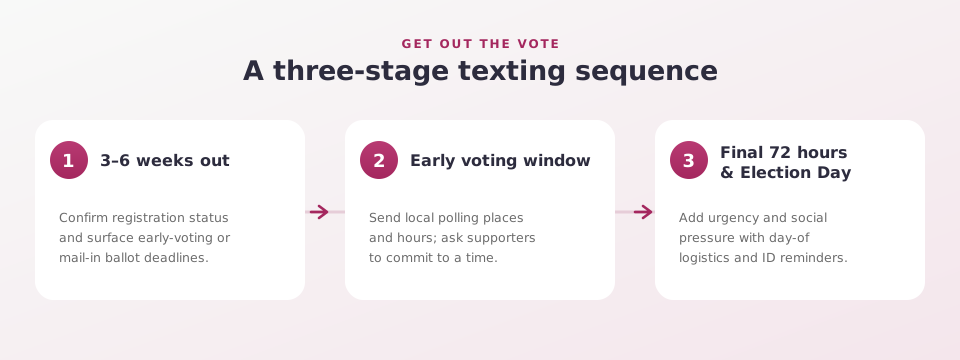
- Three to six weeks out: Confirm registration status and surface early voting or mail-in ballot deadlines before they sneak up on voters.
- The early voting window: Send localized polling place details and hours, and ask supporters to commit to a specific day and time to vote.
- The final 72 hours and Election Day: Layer in social pressure and urgency, reminding supporters their vote matters to the people around them, alongside day-of logistics like transportation options and ID requirements.
Your GOTV sequence only works if the messages actually deliver. By prioritizing a clean, fully opted-in list, you guarantee your critical final outreach bypasses carrier filters and reaches supporters without delay.
Grow your campaign with momoGood
Running a texting program well takes a partner that moves at the pace of a campaign calendar. momoGood, an AI-native platform built on Tatango’s messaging infrastructure, delivers the scale and speed campaigns need to mobilize donors and volunteers in real time.
momoGood’s political texting software is built specifically for PACs, parties, candidates, and advocacy organizations. Campaigns running on momoGood see roughly 5x return on investment, with open rates near 99%.
Some of our standout text messaging features include:
- AI-built recipient profiles that draw on giving history, event attendance, and behavioral signals, so the right ask reaches the right supporter.
- An AI copywriter that generates compliant, on-brand message variants for fundraising, GOTV, persuasion, or rapid response from a single prompt.
- Bulk sends to millions of subscribers in about a second, built for fast-moving moments like a debate reaction.
- Two-way inbox with AI triage, which routes replies to one inbox and automates routine thank-yous, while high-value donors and press inquiries get flagged to staff.
- Live A/B testing where message variants get tested mid-send, and the strongest performer is promoted automatically to the rest of your list.
- Compliance and verified infrastructure where automated consent capture and opt-out tracking run alongside 10DLC registration, STIR/SHAKEN verification, and carrier-verified short codes.
- Predictive donor scoring that surfaces the supporters most likely to give right now, instead of relying on outdated past-cycle lists.
- Two-tap SMS giving and open API where donations come in by text in two taps and tracked links can sync data to ActBlue, WinRed, Anedot, or Salesforce.
Your team should be focused on the message, not the mechanics. We provide the high-speed infrastructure, segmentation, and intelligence that political campaigns need to mobilize supporters, personalize outreach, and respond at the speed of the race. Book a demo with us to learn more and jumpstart your campaign.
momoGood handles nonprofit texting end to end — sending, replies, compliance, and text-to-give — on the same record as the rest of your fundraising.
FAQs
What are the regulations for political text messages?
Rules differ by race and election level, but a few apply broadly: opt-in consent is required, and every message needs an automated opt-out. These examples reflect federal-level guidance specifically. State and local races often add extra requirements, so confirm what applies before launching a program. The FCC’s guidance on political robocalls and robotexts is the most direct federal source.
How do you write an effective political campaign text message?
The strongest messages share three things: a single, clear ask (donate, register, show up, reply), a reason the timing matters right now, and an easy-to-find “STOP” option.
Personalization (a first name, a local landmark, a deadline) can also help your messages outperform a generic text blast, and a message making one point tends to convert better than one trying to do several.
What is a good example of a GOTV text message?
A strong GOTV text gives a supporter everything needed to act within two minutes: a reminder that Election Day or early voting is here, a polling location, hours, and what to bring.
For example, “Good morning [Name]! Polls are open until 8 PM today. Find your polling place and ID requirements here: [link]. Let’s win this — text STOP to opt out.” removes every excuse to wait.
How can political campaigns lease a short code phone number?
Most campaigns work with a texting provider that handles short code leasing and carrier registration on their behalf, since the vetting process involves carrier review that most in-house teams aren’t set up to manage alone. Lead times can run several weeks, so it’s worth starting well before a program needs to go live.
Mobilize your base instantly
Get the speed, scale, and intelligence you need to run a winning political texting program.