
Customer Story · Humanitarian Relief
Stewardship first.28x ROI second.
International Medical Corps set out to add value to its donor base by text, not just to ask. When earthquakes struck Turkey and Syria, that groundwork turned a single emergency appeal into a 28x return.
We wanted to steward our donor base. Our goal is to add value, not just ask for donations.

International Medical Corps
Most nonprofits treat SMS as an ask channel, a fast way to push a donation link when revenue needs a lift. International Medical Corps started from the opposite premise.
Their direct marketing team wanted the text channel to earn its place in a supporter's inbox before it ever asked for anything, by reporting back on what donations had actually accomplished in the field.
The Approach
Report back on impact before you ask for anything
The team built a stewardship rhythm on momoGood: rich MMS updates that showed donors exactly where their money went, country by country and crisis by crisis. No ask required.
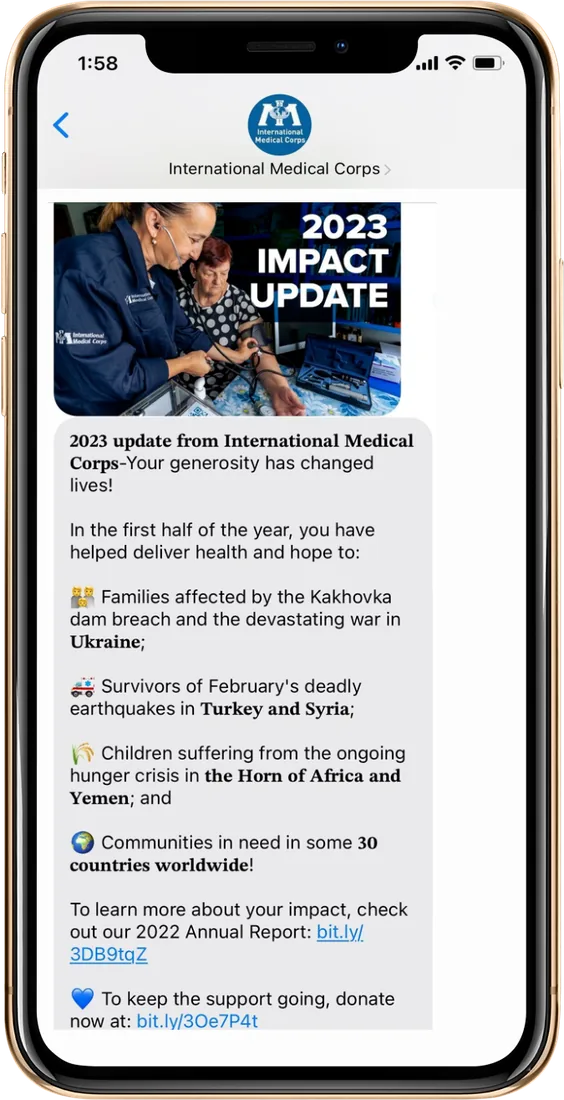
The mid-year impact update
A single MMS carried the whole year-to-date story (Ukraine, the Turkey and Syria earthquakes, the hunger crisis in the Horn of Africa and Yemen), then closed by linking the annual report. The ask came last, and it was optional.
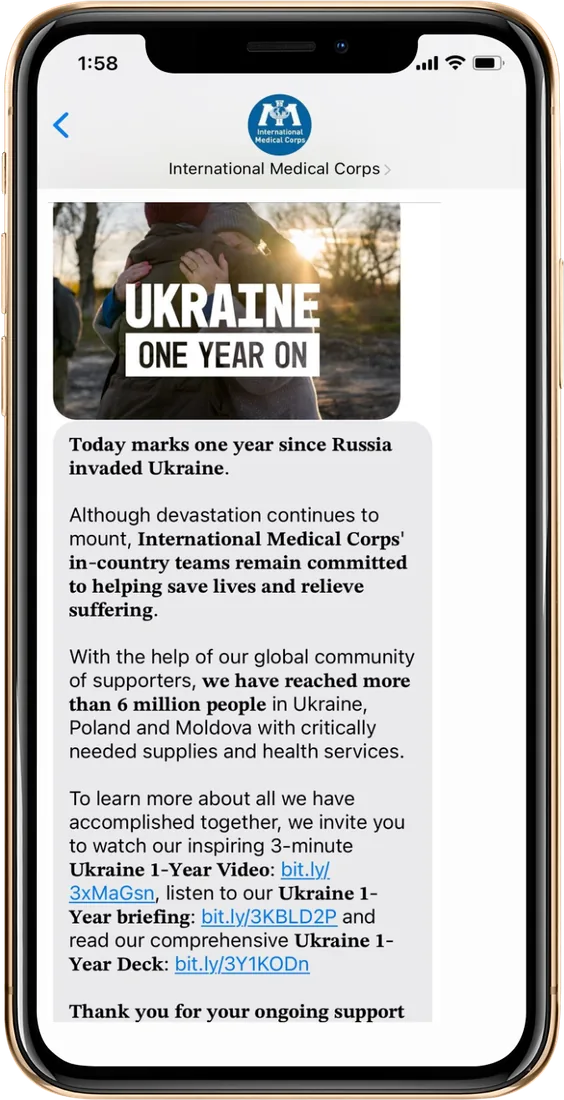
The anniversary moment
One year on from the invasion of Ukraine, the team led with the number that mattered to donors (more than 6 million people reached), then offered a video, a briefing and a deck. Three ways to go deeper, zero pressure to give.
The Moment
Then a 7.8 hit southcentral Turkey at dawn
Emergency response is a speed problem. On the morning of the Turkey and Syria earthquakes, International Medical Corps could put a broadcast MMS in front of its full permission-based list in under a minute, while the news was still breaking.
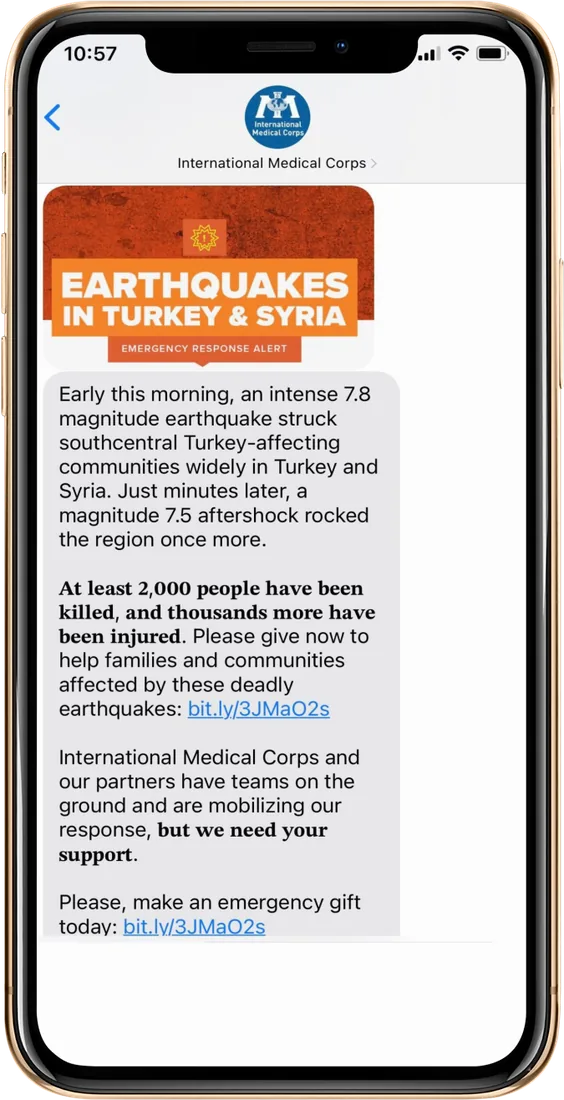
The alert that drove 28x
Facts first, then the ask: the magnitude, the aftershock, the casualty count, and the plain statement that teams were already mobilizing but needed support. This is the message behind the 28x return.
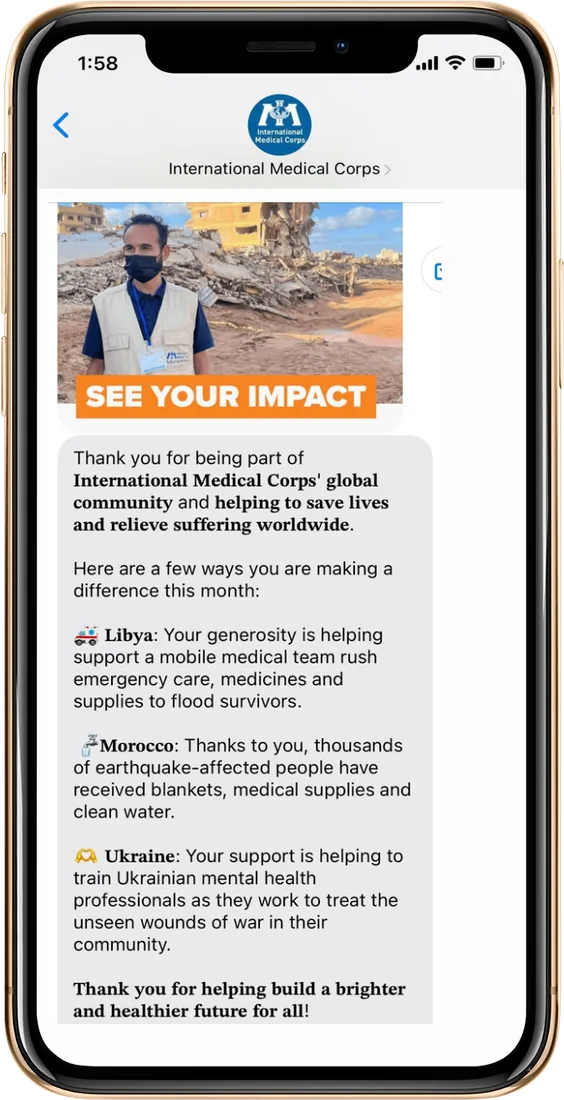
And the loop closed again
After the emergency came the receipt: Libya, Morocco, Ukraine, each with a concrete outcome attached. The cycle that made the appeal work in the first place started over.
The Playbook
Decide the format before the emergency
Emergency appeals sent within 24 hours of a major event generated 4-6x the ROI of appeals sent 48 hours or more later. Same list, same message format, same cause -- the only variable was how fast it went out.
That reframes what the platform is for. If the gap between a 24-hour appeal and a 48-hour appeal is that large, then approval chains, copy review cycles and manual list-pulling stop being process overhead and become direct revenue loss.
The disaster-response message itself was cut back to four elements and nothing else. There is no preamble and no backstory: in an emergency the donor does not need context, they need to know what happened and where to give.
- One sentence describing the crisis
- One image from the field, where one is available
- One sentence on what the gift does
- One link
What Transfers
Three things that move to any program
None of this is specific to disaster relief.
- Decide the format before the emergency. International Medical Corps did not design a message under pressure. The four-element structure existed in advance, so the only open question during an event was what to write in two sentences.
- Pre-clear the approval path. A 24-hour window does not survive a three-person sign-off chain. Decide now who can send without waiting.
- Build the list before you need it. The list gets built in calm periods and spent in urgent ones.
Emergency giving became their single most successful use of text
The stewardship program and the emergency appeal are not two separate stories. A list that has spent a year receiving proof of impact (with no ask attached) is a different list when an emergency appeal arrives.
With momoGood integrated directly into FundraiseUp, gifts landed in the same system the rest of the fundraising program already ran on. No reconciliation, no manual export.
momoGood Capabilities Used
What was running under the hood
Five platform capabilities carried this program, the same capabilities available to every momoGood nonprofit.
- Enterprise, permission-based text messagingCompliance enforced at the platform level, so every send is opt-in by construction.
- Broadcast texts: reach hundreds of thousands with one clickOne action takes a breaking crisis to a full-list send, with no queueing and no batching.
- MMS to tens of thousands in under a minuteImage-led emergency alerts delivered at the speed the news cycle moves.
- Automation, segmentation & personalizationStewardship sequences that adapt to what a supporter has already received.
- Direct integration with FundraiseUpGifts flow straight into the existing donation stack, with no manual reconciliation.

About International Medical Corps
International Medical Corps is a global humanitarian first responder. Founded in 1984 by emergency physician Dr. Robert Simon — who sold his house in Malibu to fund the start-up — it deploys medical teams into conflict, disaster and disease zones, typically arriving within the first 72 hours, then stays to train local health workers so care continues after the emergency ends. More than 96% of its staff are hired locally.
- Founded
- 1984by Dr. Robert Simon, M.D.
- Headquarters
- Los Angeles, CAPlus Washington DC, London, Split
- Chief Executive
- Nancy A. AosseyLeading the organization since 1986
- Cumulative reach
- 85+ countries$5.3B in aid delivered since 1984
Accountability

Mike partnered with the International Medical Corps team on the stewardship strategy, send cadence and emergency-response playbook behind this program.
What would a 28x emergency appeal do for your mission?
See how momoGood turns your text channel into one your donors trust before an emergency arrives.
Sources & notes
- Program results, campaign screenshots and the quote from Jessica Smit are supplied by International Medical Corps and used with permission. The 28x figure reflects return on emergency giving appeals delivered through the platform.
- Founding, leadership and staffing details: Leadership, 35 Years of Hope and Our Approach, International Medical Corps.
- FY2025 impact and financial figures: 2025 Annual Report, International Medical Corps. Program spending is 87% of the US entity's operating expenses and approximately 91% of combined global resources.
- Charity Navigator, rated on FY2024 data.
- CharityWatch, rating issued July 2026 on the fiscal year ended 30 June 2025.
- BBB Wise Giving Alliance.
- Candid Platinum Seal of Transparency as reported on International Medical Corps' accountability page.